
Woodcocks and Philosophers
The woodcock I startled yesterday
clattered off through the birch trees
without starting to philosophise
and write a book about it.
That's his way.
And that's how he survives.
It amazes me that loafing philosophers
Don't all die young.
Unless, of course, when reality
saunters by, they crash off
through book after book, without reading
one blessed word.
Norman MacCaig, in Ewen McCaig (editor), The Poems of Norman MacCaig (Polygon 2005).
A side-note: like a great deal else, philosophy isn't what it used to be, is it? One longs for those passionate, not-suffering-fools-gladly, intemperate, entertaining, exasperating, eccentric characters of yore: Kierkegaard, Schopenhauer, Leopardi (a poet-philosopher or a philosopher-poet, as you wish), and Wittgenstein come to mind. Or, to go back even further: Marcus Aurelius, Seneca, Epictetus, Heraclitus.
When it comes to sensibilities such as these, one has the feeling that philosophy is a matter of life and death, that it has something vital to do with how we live and how we die. Now, we have academic philosophy. Shot through with politics, social "science," and semantics, as one would expect. Posturing and word-play. No wonder MacCaig was skeptical, in his kindly way.

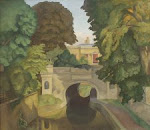
John Noble Barlow (1861-1917), "Autumn at Lamorna, Cornwall"
Here is MacCaig again:
Compare and Contrast
The great thinker died
after forty years of poking about
with his little torch
in the dark forest of ideas,
in the bright glare of perception,
leaving a legacy of fourteen books
to the world
where a hen disappeared
into six acres of tall oats
and sauntered unerringly
to the nest with five eggs in it.
Norman MacCaig, Ibid.
He is exaggerating for effect, of course. We are not woodcocks or hens: we are not as at home in ourselves, or as elegant, as they are. He is not calling for an Edenic "return to nature." His poems are full of human beings -- their joys and sorrows, their goodness and badness, and everything in between. "The great thinker" and the "loafing philosophers" are us. As are his crofters, shepherds, postmen, bus drivers, old men in pubs. Still, nature is ever-present in his poetry: mountains, lochs, trees, the sea, flowers, rain and snow, the moon, the stars, and the planets -- and the birds, always the birds. There is a back-and-forth, a balance. Human beings and nature are, by turns, the foreground and the background.

John Noble Barlow, "Marazion Marshes, Cornwall"
In an interview, MacCaig said something wonderful: "I'm bombarded with things that are loveable." (Ibid, "Quotations from MacCaig," page xlviii.) This is a capacious and beautiful view of the World, of existence. "When reality saunters by . . ." When reality saunters by, as it does each day, we should be receptive and attentive. And grateful.
Onto the rain porch
from somewhere outside it comes --
a fallen petal.
Takahama Kyoshi (1874-1959) (translated by Steven Carter), in Steven Carter, Traditional Japanese Poetry: An Anthology (Stanford University Press 1991), page 443.

John Noble Barlow, "Dewerstone, Shaugh"


