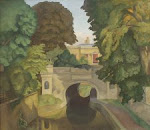
Friday, October 17, 2014

"An Honest Man Who Will Never Lie To Me"

"The most prosaic man becomes a poem when you stand by his grave at his funeral and think of him."  Thomas Hardy (notebook entry, May 29, 1871), in Richard Taylor (editor), The Personal Notebooks of Thomas Hardy (Macmillan 1978).

Perhaps this will sound hyperbolic, but I believe that what distinguishes Thomas Hardy's poetry from that of any other poet is its humanity.  No poet has ever written with such honesty, fellow-feeling, and compassion about what it means to make one's way through life, and to confront one's mortality.

These qualities do not become truly evident until one moves beyond the well-known anthology pieces and immerses oneself in Hardy's poetry as a whole.  I have been reading his poetry for nearly forty years, and I will probably never work my way through all of his 900 or so poems.  But, over time, my admiration for him, both as a poet and as a human being, continues to deepen.

Hardy's genius (there is no other word for it) is often best revealed in the small, out-of-the-way poems one unexpectedly encounters while, say, searching out an old favorite.

       The Peace-Offering

It was but a little thing,
Yet I knew it meant to me
Ease from what had given a sting
To the very birdsinging
        Latterly.

But I would not welcome it;
And for all I then declined
O the regrettings infinite
When the night-processions flit
        Through the mind!

Thomas Hardy, Moments of Vision and Miscellaneous Verses (1917).

I will go out on a limb and suggest that most of us have experienced the feelings expressed by Hardy in this poem.  Perhaps we have experienced them from both sides at different times in our lives.  Although I have read this poem many times, part of me still shies away from reading it because of the feelings I know it will evoke.  "O the regrettings infinite/When the night-processions flit/Through the mind!"  Enough said.

James Paterson, "Moniaive" (1885)

Of Hardy, Thom Gunn writes:

"[T]hroughout, there is always the feeling that he is trying to see things as they are, whether it is an abstract term like Pity or a physical thing like the way the heat of noon breathes out from old walls at midnight; he is never trying to falsify either them or his emotion about them -- and so much the worse if the poem ends up in bathos or flatness.  Ezra Pound more than once praises Hardy for his insistence on immersing himself in his subject. And this is well said, for the immersion leaves him no room for pretence, or for anything other than honesty.  Much of what sustains me through the flatter parts of the Collected Poems is this feeling of contact with an honest man who will never lie to me."

Thom Gunn, "Hardy and the Ballads," The Occasions of Poetry: Essays in Criticism and Autobiography (North Point Press 1985), page 105.

          Just the Same

I sat.  It all was past;
Hope never would hail again;
Fair days had ceased at a blast,
The world was a darkened den.

The beauty and dream were gone,
And the halo in which I had hied
So gaily gallantly on
Had suffered blot and died!

I went forth, heedless whither,
In a cloud too black for name:
-- People frisked hither and thither;
The world was just the same.

Thomas Hardy, Late Lyrics and Earlier, with Many Other Verses (1922).

Hardy's poem was no doubt prompted by a specific experience in his life, which we could perhaps tease out (as critics have tried to do) by examining the biographical details.  But that is not what makes the poem resonate with us.  Once more, I would suggest that most of us have experienced in our own lives exactly what Hardy relates in the poem.  Consider one possible instance among many:  have you ever walked out from a hospital into the sunlight after someone you love has died?

James Paterson, "Autumn in Glencairn, Moniaive" (1887)

Thom Gunn again:

"[W]e never for a moment doubt that Hardy means what he says.  We make much of 'sincerity' nowadays . . . And clearly sincerity is a value, even though one rather difficult to define -- maybe it is one of the ultimate values in literature.  But there are different ways of being sincere, and I suggest that Hardy's is a supremely successful one.
     The critics who have written on Hardy's poetry spend an inordinate time in complaining about the badness of his bad poems.  The bad poems are certainly there, but though they may be boring or ridiculous they are never pretentious.  By contrast, if you take the collected Yeats, you feel the strain of all that rhetorical striving in the minor poems, and it is only in the best of Yeats, and not always then, that he is able to free himself from the rhetoric.  Rhetoric is a form of pretence, of making something appear bigger or more important than you know it is.  Well, you never feel, even in Hardy's most boring and ridiculous poetry, that he is pretending -- he is never rhetorical.  And there are not many poets of whom this can be said."

Thom Gunn, "Hardy and the Ballads," The Occasions of Poetry, pages 104-105.

       Waiting Both

A star looks down at me,
And says:  "Here I and you
Stand, each in our degree:
What do you mean to do, --
          Mean to do?"

I say:  "For all I know,
Wait, and let Time go by,
Till my change come." -- "Just so,"
The star says:  "So mean I: --
          So mean I."

Thomas Hardy, Human Shows, Far Phantasies, Songs, and Trifles (1925).
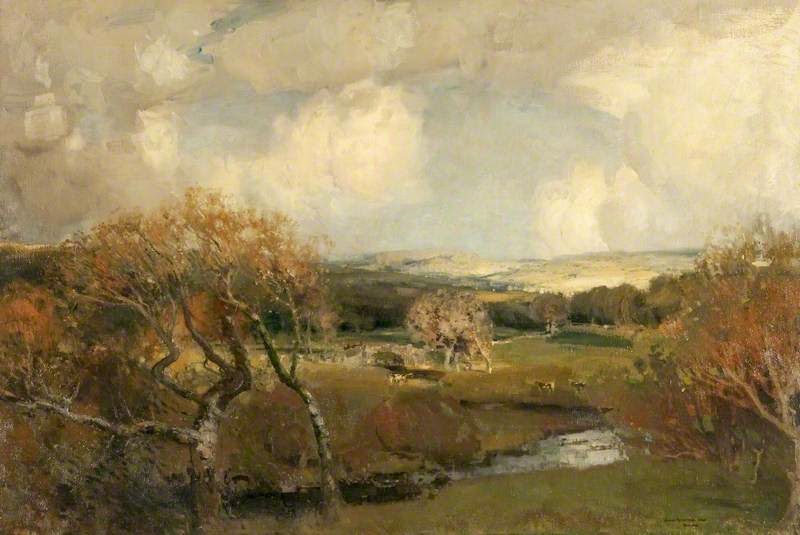
James Paterson, "Borderland" (c. 1896)

The cumulative impact of Hardy's poetry is expressed well by C. H. Sisson:

"No single poem, and no short selection, can give an adequate impression of the weight of Hardy's achievement as a poet.  The sheer bulk of closely-felt impressions, covering sixty years or more of his writing life, is without parallel in our literature.  He is no Wordsworth, hardening as the years go on, and the last poems are as lively as, and deeper than, the first.  The whole oeuvre is united by temperament and by a style which did not harden simply because it was nothing more than the words and rhythms that it was natural for Hardy to use, in his persistent impulse to set down the truth as he saw it."

C. H. Sisson, English Poetry 1900-1950: An Assessment (Methuen 1981; first published in 1971), page  30.

                       Nobody Comes

     Tree-leaves labour up and down,
          And through them the fainting light
          Succumbs to the crawl of night.
     Outside in the road the telegraph wire
          To the town from the darkening land
Intones to travellers like a spectral lyre
          Swept by a spectral hand.

     A car comes up, with lamps full-glare,
          That flash upon a tree:
          It has nothing to do with me,
     And whangs along in a world of its own,
          Leaving a blacker air;
And mute by the gate I stand again alone,
          And nobody pulls up there.

Thomas Hardy, Human Shows, Far Phantasies, Songs, and Trifles (1925).

James Paterson, "The Last Turning, Winter, Moniaive" (1885)

Monday, October 13, 2014

The Center Of The Universe

A point of clarification at the outset:  this post is not about the grandiosity, narcissism, and solipsism of human beings, whether in the public or the private sphere.  Thus, for instance, there will be no discussion of heads of state or politicians.  Their world has nothing whatsoever to do with poetry, and never will.  As Patrick Kavanagh says: "Leave Them Alone."

This is merely a meditation (of sorts) upon three poems that have swum into view by happenstance.  I'm afraid that I will not be able to provide any all-encompassing conclusions.  My only thought is that it would be nice to see the three of them together.

Here is a start:  now and then a time comes when we need to stop in place, in a clearing, and have a look around.  That space is the center of the universe.  But -- and this is crucial -- the person standing in that space is most assuredly not the center of the universe.  In fact, he or she is an infinitesimal speck.  So, what does one make of this realization?

Terrick Williams (1860-1936), "Amiens"

       Anecdote of the Jar

I placed a jar in Tennessee,
And round it was, upon a hill.
It made the slovenly wilderness
Surround that hill.

The wilderness rose up to it,
And sprawled around, no longer wild.
The jar was round upon the ground
And tall and of a port in air.

It took dominion everywhere.
The jar was gray and bare.
It did not give of bird or bush,
Like nothing else in Tennessee.

Wallace Stevens, Harmonium (1923).

Because the explication of the poetry of Wallace Stevens is an academic cottage industry in the United States, a great deal of ink has been spilled over the "meaning" of this poem.  No need to afflict ourselves with that. Let's just say that, given Stevens' belief that the exercise of Imagination upon Reality is what defines us as human beings, the identity of the jar seems fairly clear.  The jar would thus seem to be a beneficent thing.

Yet consider the final stanza.  Perhaps, after all, the jar is not fecund, as is Tennessee.  In the end, it is nothing more than "a port in air."  Maybe "the slovenly wilderness" is perfectly fine just as it is.  As I have noted previously, Stevens seemed to come around to this view -- grudgingly and by degrees -- in his last years.  But he never abandoned Imagination.  At times each of us needs to place a jar at the center of the universe, "port in air" or not.

Terrick Williams, "Clouds and Lagoons, Venice"

Stevens can be exasperatingly recondite and abstract.  The following poem brings us back to earth.  Quite literally.

                                The Glow-Worm

The pale road winds faintly upward into the dark skies,
And beside it on the rough grass that the wind invisibly stirs,
Sheltered by sharp-speared gorse and the berried junipers,
Shining steadily with a green light, the glow-worm lies.

We regard it; and this hill and all the other hills
That fall in folds to the river, very smooth and steep,
And the hangers and brakes that the darkness thickly fills
Fade like phantoms round the light and night is deep, so deep, --

That all the world is emptiness about the still flame
And we are small shadows standing lost in the huge night.
We gather up the glow-worm, stooping with dazzled sight,
And carry it to the little enclosed garden whence we came,

And place it on the short grass.  Then the shadowy flowers fade,
The walls waver and melt and the houses disappear
And the solid town trembles into insubstantial shade
Round the light of the burning glow-worm, steady and clear.

Edward Shanks, The Queen of China and Other Poems (1919).

I am reminded of fireflies and hedgehogs and octopuses in pots beneath the sea. There they are:  each of them at the center of the universe, each of them peaceful and entire.  And without a trace of grandiosity, narcissism, or solipsism.

Terrick Williams, "Amiens"

Finally, I'm not quite sure what to make of this.  But I have a sense that it belongs with the other two poems.

                                   To a Coin

Cold and stormy the night I sailed from Montevideo.
As we rounded the Cerro,
I threw from the upper deck
a coin that glinted and winked out in the muddy water,
a gleam of light swallowed by time and darkness.
I felt I had committed an irrevocable act,
adding to the history of the planet
two endless series, parallel, possibly infinite:
my own destiny, formed from anxieties, love and futile upsets
and that of that metal disk
carried away by the water to the quiet depths
or to far-off seas that still wear down
the leavings of Saxon and Viking.
Any moment of mine, asleep or wakeful,
matches a moment of the sightless coin's.
At times I have felt remorse,
at others, envy
of you, existing, as we do, in time and its labyrinth,
but without knowing it.

Jorge Luis Borges (translated by Alastair Reid), in Selected Poems (edited by Alexander Coleman) (Viking 1999).

Perhaps my sense of its belonging here comes from the last two lines in particular:  "you, existing, as we do, in time and its labyrinth,/but without knowing it."  The center of the universe is forever sliding away beneath our feet.

Terrick Williams, "St Michael's Mount, Cornwall" (1933)

Thursday, October 9, 2014

Moonlight

Why is it that certain poems dwell within us for years?  Have no fear!  I am not planning to launch into a meditation on "the art of poetry" or "the wellsprings of creativity."  Nor am I going to go anywhere near "Beauty is truth, truth beauty, -- that is all/Ye know on earth, and all ye need to know."  Discussions of that sort give me the willies.  Ditto with poems about poetry and poems about the writing of poetry.  Please, poetasters, desist!

No, this is a matter of happenstance and good fortune.  It also has something to do with, say, everything that has happened to you in your life up until the day you encounter a poem for the first time.  Oh, yes, and the season.  We mustn't forget the season.

                           Moonlit Apples

At the top of the house the apples are laid in rows,
And the skylight lets the moonlight in, and those
Apples are deep-sea apples of green.  There goes
     A cloud on the moon in the autumn night.

A mouse in the wainscot scratches, and scratches, and then
There is no sound at the top of the house of men
Or mice; and the cloud is blown, and the moon again
     Dapples the apples with deep-sea light.

They are lying in rows there, under the gloomy beams;
On the sagging floor; they gather the silver streams
Out of the moon, those moonlit apples of dreams,
     And quiet is the steep stair under.

In the corridors under there is nothing but sleep.
And stiller than ever on orchard boughs they keep
Tryst with the moon, and deep is the silence, deep
     On moon-washed apples of wonder.

John Drinkwater, Tides (1917).

I cannot recall when I first came across "Moonlit Apples."  Twenty years ago?  Thirty?  (I had best stop there, lest I disappear down a narrowing, darkening tunnel.)  I suspect that I found it in Georgian Poetry: 1918-1919. I have a copy of that volume beside me as I write this, and there it is at page 50.  But I may have happened upon it in another anthology.  I'm not certain.  However, I do remember my mounting wonderment and excitement as I read it for the first time.  And I am humbled, and grateful, to say that those feelings have never left me.

Albert Goodwin (1845-1932), "Florence, Evening" (1896)

I have intentionally sought not to pick apart what makes "Moonlit Apples" -- at least for me -- beautiful.  As long-time (and much-appreciated!) readers know, my oft-stated basic principle is this:  Explanation and explication are the death of poetry.  Yet here I am writing about poems. And I will no doubt violate my principle by suggesting that the following poem has something to do with what makes "Moonlit Apples" -- or any other poem or work of art -- beautiful.

                    Note on Moonlight

The one moonlight, in the simple-colored night,
Like a plain poet revolving in his mind
The sameness of his various universe,
Shines on the mere objectiveness of things.

It is as if being was to be observed,
As if, among the possible purposes
Of what one sees, the purpose that comes first,
The surface, is the purpose to be seen,

The property of the moon, what it evokes.
It is to disclose the essential presence, say,
Of a mountain, expanded and elevated almost
Into a sense, an object the less; or else

To disclose in the figure waiting on the road
An object the more, an undetermined form
Between the slouchings of a gunman and a lover,
A gesture in the dark, a fear one feels

In the great vistas of night air, that takes this form,
In the arbors that are as if of Saturn-star.
So, then, this warm, wide, weatherless quietude
Is active with a power, an inherent life,

In spite of the mere objectiveness of things,
Like a cloud-cap in the corner of a looking-glass,
A change of color in the plain poet's mind,
Night and silence disturbed by an interior sound,

The one moonlight, the various universe, intended
So much just to be seen -- a purpose, empty
Perhaps, absurd perhaps, but at least a purpose,
Certain and ever more fresh.  Ah!  Certain, for sure . . .

Wallace Stevens, The Rock (1954).

As I have noted in previous posts, the poetry of Wallace Stevens' final years displays an acceptance of -- and love for -- the World as it is, with less of an insistence on asserting the primacy of the Imagination over Reality.  Of course, he never surrendered entirely.  After all, writing poetry was for him the quintessential activity of the Imagination.  One can see this tug-of-war take place in "Note on Moonlight," which was published less than a year prior to his death at the age of 75.

The final stanza is, I think, one of the most moving things that Stevens ever wrote.  "Intended so much just to be seen" is wonderful.  And how about that last line?

Harold Speed, "The Alcantara, Toledo, by Moonlight" (1894)

The following poem appears on the page facing "Moonlit Apples" in John Drinkwater's 1917 collection Tides.  They make a lovely pair.

               Out of the Moon

Merely the moonlight
Piercing the boughs of my may-tree,
Falling upon my ferns;
Only the night
Touching my ferns with silver bloom
Of sea-flowers here in the sleeping city --
And suddenly the imagination burns
With knowledge of many a dark significant doom
Out of antiquity,
Sung to hushed halls by troubadours
Who knew the ways of the heart because they had seen
The moonlight washing the garden's deeper green
To silver flowers,
Falling with tidings out of the moon, as now
It falls on the ferns under my may-tree bough.

John Drinkwater, Tides (1917).

Terrick Williams, "Quiet Twilight, Honfleur" (c. 1922)

As I have noted on more than one occasion, Japanese and Chinese poems often help to put our longer-winded English lyrical apostrophes into perspective.

     Autumn's bright moon,
However far I walked, still afar off
     In an unknown sky.

Chiyo-ni (1703-1775) (translated by R. H. Blyth), in R. H. Blyth, Haiku, Volume 3: Summer-Autumn (Hokuseido 1952), page 388.

     Down from the mountain,
The moon
     Accompanied me,
And when I opened the gate,
The moon too entered.

Kotomichi (1798-1868) (translated by R. H. Blyth), Ibid, page 388.

Albert Goodwin, "Salisbury"

Sunday, October 5, 2014

Leaves

The Greek Anthology is, to a great degree, a chronicle of "change and chancefulness" (Thomas Hardy, "The Temporary the All"), woven through with a gentle and stoic thread of admonition:  Live well.  But be ever aware of That which awaits us all.  In other words, it is the perfect volume to peruse during the heart of autumn.  Doing so this week, I came upon this:

All human things are subject to decay;
And well the man of Chios tuned his lay,
"Like leaves on trees the race of man is found."
Yet few receive the melancholy sound,
Or in their breasts imprint this solemn truth;
For hope is near to all, but most to youth.
Hope's vernal season leads the laughing hours,
And strews o'er every path the fairest flowers.
To cloud the scene no distant mists appear,
Age moves no thought, and death awakes no fear.
Ah, how unmindful is the giddy crowd
Of the small span to youth and life allow'd!
Ye who reflect, the short-lived good employ,
And while the power remains, indulge your joy.

Simonides (translated by J. H. Merivale), in Robert Bland (editor), Collections from The Greek Anthology, and from the Pastoral, Elegiac, and Dramatic Poets of Greece (1813), page 185.

This sort of poem or epigram appears again and again in The Greek Anthology.  I readily confess that I cannot get enough of such things.  Mere truisms?  Yes, of course!  And wonderfully so.

James Torrington Bell (1898-1970), "Landscape"

The third line of Merivale's translation of Simonides' poem is taken from Alexander Pope's translation of Book VI of The Iliad.  "The man of Chios" (line 2) is Homer, who, by tradition, was thought to have been born on Chios, an island in the Aegean Sea in the region once known as Ionia. Which brings to mind (please pardon the digression) these lines from C. P. Cavafy's lovely poem "Ionic": "That we've broken their statues,/that we've driven them out of their temples,/doesn't mean at all that the gods are dead./O land of Ionia, they're still in love with you,/their souls still keep your memory."  (Translated by Edmund Keeley and Philip Sherrard.)

Here is Pope's line in context:

Like leaves on trees the race of man is found,
Now green in youth, now with'ring on the ground:
Another race the foll'wing spring supplies,
They fall successive, and successive rise;
So generations in their course decay,
So flourish these, when those are past away.

Here are the same lines of Homer as rendered by William Cowper:

For, as the leaves, such is the race of man.
The wind shakes down the leaves, the budding grove
Soon teems with others, and in spring they grow.
So pass mankind.  One generation meets
Its destined period, and a new succeeds.

James Sheard (1866-1921), "The Pride of Autumn"

All of this leads me inevitably to one of my favorite poems by Thomas Hardy, a poem that calls to me each year.  The poem has appeared here before, but, as long-time (and much-appreciated!) readers know, we need to circle back now and then to see how these things look in a new light.

   Autumn in King's Hintock Park

Here by the baring bough
     Raking up leaves,
Often I ponder how
     Springtime deceives, --
I, an old woman now,
     Raking up leaves.

Here in the avenue
     Raking up leaves,
Lords' ladies pass in view,
     Until one heaves
Sighs at life's russet hue,
     Raking up leaves!

Just as my shape you see
     Raking up leaves,
I saw, when fresh and free,
     Those memory weaves
Into grey ghosts by me,
     Raking up leaves.

Yet, Dear, though one may sigh,
     Raking up leaves,
New leaves will dance on high --
     Earth never grieves! --
Will not, when missed am I
     Raking up leaves.

Thomas Hardy, Time's Laughingstocks and Other Verses (1909).

I wonder:  did Hardy have Homer in mind when he wrote this?  Part of me hopes that he did not.  I love the thought of these two great poets arriving at the same place on their own, centuries apart.

Among the many beauties of the poem, this, in particular, always moves me:  "Earth never grieves!"

Andrew McCallum, "Oak Trees in Sherwood Forest" (1877)

I will close with two down-to-earth codas to this seasonal, generational, and cosmic falling and rising, rising and falling.

     Blowing from the west,
Fallen leaves gather
     In the east.

Yosa Buson (1716-1784) (translated by R. H. Blyth), in R. H. Blyth, Haiku, Volume 4: Autumn-Winter (Hokuseido 1952), page 362.

     People are few;
A leaf falls here,
     Falls there.

Kobayashi Issa (1763-1828) (translated by R. H. Blyth), Ibid, page 364.

James Bateman, "Lulington Church" (1939)

Wednesday, October 1, 2014

Abundance

And so we move into October.  Leaves are the first thing that comes to mind, at least for me.  Those bearers of joy and wistfulness.  There can never be enough of them, can there?

Placing so much value on them now, wishing them to stay longer as they disappear, I wonder whether I gave them the attention they deserved from spring through summer.  "First known when lost."  Or something like that.

I am reminded of two lines from a poem by Ishikawa Jozan (1583-1672) about fallen cherry blossoms in spring:  "When blossoms were at their finest I neglected to call./The blossoms did not betray me.  I betrayed the blossoms."  Burton Watson (editor and translator), Kanshi: The Poetry of Ishikawa Jozan and Other Edo-Period Poets (North Point Press 1990).

                      Economic Man

He would have liked to find a use for leaves,
So simple a thing it seemed, so many of them
Flying and falling, going to waste and wet
And stopping up the gutters and the drains
Or drying in the still November days
Until swept into heaps, gone up in smoke
As if all summer's shade had never been.

And so he dreamed, and idly enough,
For many summers, many falls, until
His spell upon the earth was done, come time
To fall, while the useless leaves still came and went,
And the green had told him nothing, nor the sere,
That he might leave for men to profit by.

Howard Nemerov, War Stories: Poems about Long Ago and Now (University of Chicago Press 1987).

Funny thing about leaves:  they have no agenda; they pay us no mind. Imagine being nothing but yourself.

John Milne Donald, "Autumn Leaves" (1864)

However many years pass, my heart-of-autumn feeling will always come from 50 or so years ago, in the lost land of Minnesota.  The earthy scent that comes after jumping into a pile of raked-up oak leaves.  At dusk, looking down the street at neighbors standing beside their smoky piles of burning leaves.  No, we shan't have any of that anymore, shall we? Someone's idea of "Progress":  an autumn world without the smell of burning leaves.

   Gathering Leaves

Spades take up leaves
No better than spoons,
And bags full of leaves
Are light as balloons.

I make a great noise
Of rustling all day
Like rabbit and deer
Running away.

But the mountains I raise
Elude my embrace,
Flowing over my arms
And into my face.

I may load and unload
Again and again
Till I fill the whole shed,
And what have I then?

Next to nothing for weight,
And since they grew duller
From contact with earth,
Next to nothing for color.

Next to nothing for use.
But a crop is a crop,
And who's to say where
The harvest shall stop?

Robert Frost, New Hampshire (1923).

"And who's to say where/The harvest shall stop?"  Is this one of those mischievous Frostian endings?  Is it an expression of joy at the inexhaustible beauty of the wondrous World around us?  Or is it a reminder of mortality?

Alexander Brownlie Docharty, "An Autumn Day" (c. 1917)

All of this abundance comes our way unbidden, unasked for.

The wind has brought
     enough fallen leaves
To make a fire.

Ryokan (1758-1831) (translated by John Stevens), in John Stevens, One Robe, One Bowl: The Zen Poetry of Ryokan (Weatherhill 1977).

As I suggested in a recent post:  gratitude ought to be with us always. "Who's to say where the harvest shall stop?"

William Samuel Jay, "At the Fall of Leaf, Arundel Park, Sussex" (1883)

Saturday, September 27, 2014

Green Slates. A Floor Of Red Tiles And Blue. Crushed Bracken And The Wings Of Doves. Moth And Gnat And Cobweb-Time.

It's funny, the things that stay with us in memory.  Births, deaths, and other milestones, yes.  But what are we to make of the clarity and persistence of certain seemingly random moments out of the past?

But, then, they are not random after all, are they?  There is a reason for their clarity, their tug and pull.  I suspect that most of us know quite well the buried emotions that these revenants carry with them.  Speaking solely for myself, I have become adept at not going down the turning paths that lead to these all-too-clear vales of memory.  Why?  Nothing dire or secretive.  Merely something along these lines:

I know not how, but as I count
     The beads of former years,
Old laughter catches in my throat
     With the very feel of tears.

Robert Louis Stevenson, New Poems and Variant Readings (1918).

An unacceptable and cowardly excuse, I know.  One ought to view the survival of emotions -- both good and bad -- as a treasure.  And I do, I do. Yet . . .

Benjamin Leader, "Betws-y-Coed Church" (1863)

To a large extent, Thomas Hardy's poetry is an exercise in the recovery and recounting of the past.  One gets the feeling that he spent much of his life inhabiting the past -- actually reliving it.  He wrote of himself:  "I believe it would be said by people who knew me well that I have a faculty (possibly not uncommon) for burying an emotion in my heart or brain for forty years, and exhuming it at the end of that time as fresh as when interred."  Thomas Hardy, The Life and Work of Thomas Hardy (edited by Michael Millgate) (Macmillan 1985), page 408.  One can thus understand why Hardy's poems concerning incidents from his past bear such immediacy and emotion.  One suspects this was both a blessing and a curse.

                    Green Slates
                     (Penpethy)

It happened once, before the duller
     Loomings of life defined them,
I searched for slates of greenish colour
     A quarry where men mined them;

And saw, the while I peered around there,
     In the quarry standing
A form against the slate background there,
     Of fairness eye-commanding.

And now, though fifty years have flown me,
     With all their dreams and duties,
And strange-pipped dice my hand has thrown me,
     And dust are all her beauties,

Green slates -- seen high on roofs, or lower
     In waggon, truck, or lorry --
Cry out:  "Our home was where you saw her
     Standing in the quarry!"

Thomas Hardy, Human Shows, Far Phantasies, Songs, and Trifles (1925).


Benjamin Leader, "On The Llugwy Below Capel Curig" (1903)

The moments of which I speak are notable for their ostensible ordinariness.  Yet, even as they occur, we often have an inkling that something has clicked, that we have arrived at a moment out of time that will for ever be with us.

                              History

Sometimes, when walls and occupation seem
A prison merely, a dark barrier
Between me everywhere
And life, or the larger province of the mind,
As dreams confined,
As the trouble of a dream,
I seek to make again a life long gone,
To be
My mind's approach and consolation,
To give it form's lucidity,
Resilient form, as porcelain pieces thrown
In buried China by a wrist unknown,
Or mirrored brigs upon Fowey sea.

Then to my memory comes nothing great
Of purpose, or debate,
Or perfect end,
Pomp, nor love's rapture, nor heroic hours to spend --
But most, and strangely, for long and so much have I seen,
Comes back an afternoon
Of a June
Sunday at Elsfield, that is up on a green
Hill, and there,
Through a little farm parlour door,
A floor
Of red tiles and blue,
And the air
Sweet with the hot June sun cascading through
The vine-leaves under the glass, and a scarlet fume
Of geranium flower, and soft and yellow bloom
Of musk, and stains of scarlet and yellow glass.

Such are the things remain
Quietly, and for ever, in the brain,
And the things that they choose for history-making pass.

John Drinkwater, Loyalties (1922).

Benjamin Leader, "Haymaking" (1876)

The following poem has appeared here before, but it is worth revisiting, for it captures perfectly what I am (inarticulately) trying to get at.

                         Revaluation

Now I remember nothing of our love
So well as the crushed bracken and the wings
Of doves among dim branches far above --
Strange how the count of time revalues things!

Patrick MacDonogh, Poems (edited by Derek Mahon) (The Gallery Press 2001).

Benjamin Leader, "At Evening Time It Shall Be Light" (1897)

I suggested above that Thomas Hardy "spent much of his life inhabiting the past."  This was not, however, a matter of escapism into a happier world. Sometimes, perhaps, it was:  for instance, when he was recalling his younger years with his family.  Much of the time, however, he was revisiting loss.

                       The Rift
            (Song: Minor Mode)

'Twas just at gnat and cobweb-time,
When yellow begins to show in the leaf,
That your old gamut changed its chime
From those true tones -- of span so brief! --
That met my beats of joy, of grief,
            As rhyme meets rhyme.

So sank I from my high sublime!
We faced but chancewise after that,
And never I knew or guessed my crime. . . .
Yes; 'twas the date -- or nigh thereat --
Of the yellowing leaf; at moth and gnat
            And cobweb-time.

Thomas Hardy, Late Lyrics and Earlier, with Many Other Verses (1922).

"At moth and gnat and cobweb-time."  Lines such as this remind us that, at heart, Hardy was, and always remained, a countryman.  Time and again in his poetry we experience this interrelationship between the particulars of the seasons and the playing out of human destiny.  But not in a manipulative sense.  The two worlds move forward in their own courses. At times, they are indifferent to, and separate from, one another.  At other times, they are entirely intertwined.  But Hardy's vision was capacious and all-encompassing:  he could not imagine the one without the other.  Thus, remembering a loss, cobweb-time came to mind.  When yellow begins to show in the leaf.

Benjamin Leader, "Quiet Valley Among The Welsh Hills" (1860)

Tuesday, September 23, 2014

Transformations

I do not accept the common caricature of Thomas Hardy as a "pessimist." Poets who report things as they see them are often pigeon-holed as "pessimists" by those who have not taken the time to actually read the poetry.  Philip Larkin is often caricatured (wrongly) in the same fashion. As it turns out, few poets have written about the human condition and individual human beings with as much wisdom, sensitivity, empathy, and compassion as have Hardy and Larkin, the purported "pessimists."

Beyond this, there is an interesting cosmological thread that runs through Hardy's poetry.  It is true that he viewed the Cosmos (or Existence or the Universe) as something that is, at best, indifferent to our fate.  Hence, we find him referring to "Crass Casualty," "purblind Doomsters," and the like. There is no denying that he possessed a tragic sense of life.

But there is another side of Hardy that can be described as serene, and accepting, in the face of this state of affairs.  This serenity and acceptance arise from a sense of -- I am wary of using these words -- oneness and continuity, of timelessness in the midst of unceasing change.  This was not the product of any theological principles.  Hardy did not go in for those.

But I should stop, and let the poems speak for themselves.

                                In a Museum

                                           I
Here's the mould of a musical bird long passed from light,
Which over the earth before man came was winging;
There's a contralto voice I heard last night,
That lodges in me still with its sweet singing.

                                           II
Such a dream is Time that the coo of this ancient bird
Has perished not, but is blent, or will be blending
Mid visionless wilds of space with the voice that I heard,
In the full-fugued song of the universe unending.

Thomas Hardy, Moments of Vision and Miscellaneous Verses (1917).

The bird of the poem is a fossil of archaeopteryx, which Hardy saw in the Albert Memorial Museum in Exeter in 1915.  J. O. Bailey, The Poetry of Thomas Hardy: A Handbook and Commentary (University of North Carolina Press 1970), page 345.

Call me dreamy, addle-pated, and/or old-fashioned, but I love a poet who writes without irony of the "visionless wilds of space" and "the full-fugued song of the universe unending."

John Aldridge (1905-1983), "First Frost"

Later in the same volume -- which was published in Hardy's 77th year -- we find this:

               The Occultation

When the cloud shut down on the morning shine,
        And darkened the sun,
I said, "So ended that joy of mine
        Years back begun."

But day continued its lustrous roll
        In upper air;
And did my late irradiate soul
        Live on somewhere?

Thomas Hardy, Moments of Vision and Miscellaneous Verses.

The OED defines "irradiate" as: "illumined; made bright or brilliant."

John Aldridge, "The River Pant Near Sculpin's Bridge" (1961)

As I have noted on previous occasions, Hardy is at home in graveyards.  In Hardy's poetry, casual conversations with ghosts are a common occurrence, and are no cause for alarm.  It thus makes perfect sense that those who have departed are likely to find their way back into our World via other avenues.  Nothing ever vanishes.  A comforting thought, I think.  One that cannot be proven, of course.  But that is of no moment.

       Transformations

Portion of this yew
Is a man my grandsire knew,
Bosomed here at its foot:
This branch may be his wife,
A ruddy human life
Now turned to a green shoot.

These grasses must be made
Of her who often prayed,
Last century, for repose;
And the fair girl long ago
Whom I often tried to know
May be entering this rose.

So, they are not underground,
But as nerves and veins abound
In the growths of upper air,
And they feel the sun and rain,
And the energy again
That made them what they were!

Thomas Hardy, Ibid.

John Aldridge, "The Pink Farm" (1940)

All of this is reminiscent of a poem that has appeared here before, a poem that was written on the other side of the world eleven centuries or so before Hardy wrote these three poems.

          Climbing the Ling-Ying Terrace and Looking North

Mounting on high I begin to realize the smallness of Man's Domain;
Gazing into distance I begin to know the vanity of the Carnal World.
I turn my head and hurry home -- back to the Court and Market,
A single grain of rice falling -- into the Great Barn.

Po Chu-i (translated by Arthur Waley), in Arthur Waley, One Hundred and Seventy Chinese Poems (1918).

That's it, isn't it?  "A single grain of rice falling -- into the Great Barn." More than enough for one life.

John Aldridge, "Beslyn's Pond, Great Bardfield"

Friday, September 19, 2014

"An Act Never Is Worthier Than In Freeing Spirit That Stifles Under Ingratitude's Weight"

As I age, one of my resolutions is this:  Don't be querulous.  The flip side is this:  Be grateful.  I don't claim to be without fault in obeying my own resolutions.  But I try to keep them in mind.

On a daily basis the news of the world arrives at our virtual doorstep.  The news is rarely good.  In fact, it is usually horrific.  Otherwise it would not be news.  Our personal lives are, like all else, subject to the vacillations of constant change, good and bad.  Permanent bliss with happy faces all around is not our lot, I'm afraid.  But this state of affairs ought not to preclude gratitude.

If I may be forgiven a personal note.  Earlier this year, I received the proverbial wake-up call in the middle of the night (2:15 a.m., to be exact) bringing news of personal loss from half a world away.  Today I watched a row of trees shedding yellow leaves in the wind against a dark grey sky.

Eliot Hodgkin, "Dead Leaves and Birds' Eggs" (1963)

                           The Escape

I believe in the increasing of life whatever
Leads to the seeing of small trifles . . . . . .
Real, beautiful, is good, and an act never
Is worthier than in freeing spirit that stifles
Under ingratitude's weight; nor is anything done
Wiselier than the moving or breaking to sight
Of a thing hidden under by custom; revealed
Fulfilled, used, (sound-fashioned) any way out to delight.
.     .     .     .     .     .     .     .     .     .     .     .     .     .     .     .     .     .
Trefoil . . . . hedge sparrow . . . the stars on the edge of night.

Ivor Gurney, Selected Poems (edited by George Walter) (J. M. Dent 1996). All of the ellipses appear in the original.

Ivor Gurney can embarrass you into gratitude for life and its never-ending wonders.  He most likely wrote "The Escape" in the autumn of 1923, after he had been involuntarily committed to an asylum.  But this is certainly not the poem of a madman.  Far from it.  From the beginning to the end of his life, Gurney never ceased to love and treasure everything in the World, no matter how humble.  We all can learn from him.

Eliot Hodgkin, "Seven Brussel Sprouts" (1955)

Here is another way of looking at things, working from the inside out.

          Poem Written in a Copy of Beowulf

At various times I have asked myself what reasons
moved me to study while my night came down,
without particular hope of satisfaction,
the language of the blunt-tongued Anglo-Saxons.
Used up by the years my memory
loses its grip on words that I have vainly
repeated and repeated.  My life in the same way
weaves and unweaves its weary history.
Then I tell myself:  it must be that the soul
has some secret sufficient way of knowing
that it is immortal, that its vast encompassing
circle can take in all, accomplish all.
Beyond my anxiety and beyond this writing
the universe waits, inexhaustible, inviting.

Jorge Luis Borges (translated by Alastair Reid), Selected Poems (edited by Alexander Coleman) (Viking 1999).

"The universe waits, inexhaustible, inviting."  If we think of the universe in this fashion, how can we approach it -- and our own life -- with anything but gratitude?

Eliot Hodgkin, "Feathers and Hyacinth Heads" (1962)

Again, Ivor Gurney:

            Common Things

The dearness of common things --
Beech wood, tea, plate-shelves,
And the whole family of crockery --
Wood-axes, blades, helves.

Ivory milk, earth's coffee,
The white face of books
And the touch, feel, smell of paper --
Latin's lovely looks.

Earth fine to handle;
The touch of clouds,
When the imagining arm leaps out to caress
Grey worsted or wool clouds.

Wool, rope, cloth, old pipes
Gone, warped in service;
And the one herb of tobacco,
The herb of grace, the censer weed,
Of whorled, blue, finger-traced curves.

Ivor Gurney, Selected Poems.

Eliot Hodgkin, "Five Oyster Shells" (1961)

To revisit, with apologies, a statement that has appeared here on more than one occasion:  "Not how the world is, is the mystical, but that it is." Ludwig Wittgenstein, Tractatus Logico-Philosophicus, Proposition 6.44 (italics in original) (translated by C. K. Ogden) (1921).

                             The Miracles

What things I have missed today, I know very well
But the seeing of them each new time is miracle,
Nothing between Bredon and Dursley has
Anyday yesterday's precise unpraised grace.
The changed light, or curve changed mistily
Coppice now bold cut:  yesterday's mystery.
A sense of mornings, once seen, for ever gone,
Its own for ever; alive, dead, my possession.

Ivor Gurney, Selected Poems.

Words like "mystical" (Wittgenstein), "soul" (Borges), and "miracle" (Gurney) cause many moderns to feel uncomfortable.  They regard the words with irony.  (Irony being their primary way of looking at the World.) The twin gospels of Science and Progress make such words, and those who utter them, seem old-fashioned, out-of-sync.  But these things are a matter of belief all the way around, aren't they?

Eliot Hodgkin, "Six Cape Gooseberries" (1954)

Monday, September 15, 2014

The Names Of Stars

I do not know the names of stars.  I have come across them in reading, of course.  But, looking at the crowded sky, I cannot place the names to the faces.  Though I find the faces beautiful and entrancing.

Mind you, I am not flaunting my ignorance.  I would love to find myself in the company of someone who could look up into that vastness and begin to name names.  In the same way, I admire those who can rattle off the Latin binomials for flora and fauna.  But my resources are limited.  As I have noted before, I am the sort of person who reads a poem or two a day, and then needs to turn them over and over, daydreaming all the while. Becoming a namer of stars is simply not in the cards, I'm afraid.

I do, however, have a favorite piece of star-lore.  What we, in English, call "the Milky Way," the Japanese call ama-no-gawa:  "river of the heavens" or "river of the sky" or "river of Heaven."  I believe that I can locate the river of Heaven, if pressed.

Graham Sutherland, "Lammas" (1926)

This apostrophe on my ignorance was prompted by coming across the following poem.

                         The South

To have watched from one of your patios
the ancient stars,
from the bench of shadow to have watched
those scattered lights
that my ignorance has learned no names for,
nor their places in constellations,
to have heard the note of water
in the cistern,
known the scent of jasmine and honeysuckle,
the silence of the sleeping bird,
the arch of the entrance, the damp
-- these things perhaps are the poem.

Jorge Luis Borges (translated by W. S. Merwin), Selected Poems (edited by Alexander Coleman) (Viking 1999).

"The silence of the sleeping bird" is particularly nice, I think.

Paul Drury, "September" (1928)

Still, the naming of stars is a lovely thing, reminiscent of the naming of flowers:  heart's ease, lad's love, forget-me-nots . . .  Thomas Hardy's phrase "constellated daisies" comes suddenly to mind, as well as Andrew Young's lines about a field of daisies at night:  "For where the folded daisies are/In every one I see a star."

                    Mirach, Antares . . .

Mirach, Antares, Vega, Caph, Alcor --
From inch-wide eyes I scan their aeon-old flames,
Enthralled:  then wonder which enchants me more --
They, or the incantation of their names.

Walter de la Mare, Inward Companion: Poems (1950).

Beset with insomnia, Ivor Gurney often went on night-long walks in the country and the city.  Not surprisingly, stars and their constellations often appear in his poetry as his companions on these walks.

                         Stars Sliding

The stars are sliding wanton through trees,
The sky is sliding steady over all.
Great Bear to Gemini will lose his place
And Cygnus over world's brink slip and fall.

Follow-my-Leader's not so bad a game.
But were it leap frog:  O to see the shoots
And tracks of glory; Scorpions and Swans tame
And Argo swarmed with Bulls and other brutes.

Ivor Gurney, Selected Poems (edited by George Walter) (J. M. Dent 1996).

Graham Sutherland, "Michaelmas" (1928)

Finally, on constellations, there is this.  We cannot say for certain that it was composed by Edward Thomas.  But we do know that it was found on a page in his daughter Bronwen's autograph album.  It is untitled.

This is the constellation of the Lyre:
Its music cannot ever tire,
For it is silent.  No man need fear it:
Unless he wants to, he will not hear it.
                                                         E. T.

Cardiff University Library Archive
The First World War Poetry Digital Archive (Oxford)

Thursday, September 11, 2014

Harbors

I have been in a vague 1920s mood this week, and thus found myself perusing Georgian Poetry, 1920-1922, the final installment of Edward Marsh's five-volume series that began in December of 1912.  There is something homely (in the sense of "simple, plain, unsophisticated") and comforting about these volumes, with their paper-covered boards, gilt-lettering, and now age-toned pages.

I realize that I am constructing a dream-world:  how can I possibly say that I have been in "a vague 1920s mood this week" when I have no conception of what the 1920s were like in England, across the sea?  But escapism is what it is.  I confess:  at times I long for a different world entirely.

Yes, I know that human nature was no different then, that a horrific war had just ended, and that economic calamity and another war were on the horizon.  Yet there is something fundamentally decent, restrained, circumspect, and seemly about the poems one encounters in Marsh's anthologies.  Something that is the exact opposite of the world in which we now find ourselves.

Richard Eurich, "Dorset Cove" (1939)

Earlier this year I posted poems by William Kerr and J. D. C. Pellow that appeared in Georgian Poetry, 1920-1922.  A few days ago, I discovered this poem in the same volume.

                              Evening

When little lights in little ports come out,
Quivering down through water with the stars,
And all the fishing fleet of slender spars
Range at their moorings, veer with tide about;

When race of wind is stilled and sails are furled,
And underneath our single riding-light
The curve of black-ribbed deck gleams palely white,
And slumbrous waters pool a slumbrous world;

-- Then, and then only, have I thought how sweet
Old age might sink upon a windy youth,
Quiet beneath the riding-light of truth,
Weathered through storms, and gracious in retreat.

Vita Sackville-West (1892-1962).  The poem was originally published in Orchard and Vineyard (1921).

The image of the lights of the village "quivering down through water with the stars" is particularly fine.  As is "slumbrous waters pool a slumbrous world."  And, at my age, I find the concluding lines something to aspire to. (Although I have no illusions about "the riding-light of truth" beaming overhead!  But, as for "gracious in retreat":  one would hope so.)

Richard Eurich, "Robin Hood's Bay in Wartime" (1940)

I have a soft spot for poems set in peaceful harbors at night.  Hence, "Evening" brought this poem to mind (which, coincidentally, was also published in 1921).

                       Boats at Night

How lovely is the sound of oars at night
     And unknown voices, borne through windless air,
From shadowy vessels floating out of sight
     Beyond the harbour lantern's broken glare
To those piled rocks that make on the dark wave
     Only a darker stain.  The splashing oars
Slide softly on as in an echoing cave
     And with the whisper of the unseen shores
Mingle their music, till the bell of night
     Murmurs reverberations low and deep
That droop towards the land in swooning flight
     Like whispers from the lazy lips of sleep.
The oars grow faint.  Below the cloud-dim hill
The shadows fade and now the bay is still.

Edward Shanks (1892-1953), The Island of Youth and Other Poems (1921).

Think of it:  T. S. Eliot's The Waste Land would be published in the following year.  I was once entranced by it, and I still find it . . . interesting. But it now seems overwrought.  And Eliot seems full of himself.  When it comes to "modernism," I suppose I am an apostate.  "Evening" and "Boats at Night" seem more, well, human.  These sorts of poems may not be ironic enough, or unillusioned enough, for some "modern" tastes.  They certainly do not pass muster for the avant-garde.  They are unashamedly "old-fashioned."  All the better.

Richard Eurich, "In Falmouth Harbour" (1935)

Finally, a poem which (for me, at least) has the same evocative feeling as the poems by Sackville-West and Shanks.

     A Ship, an Isle, a Sickle Moon

A ship, an isle, a sickle moon --
With few but with how splendid stars
The mirrors of the sea are strewn
Between their silver bars!
          *     *     *
An isle beside an isle she lay,
The pale ship anchored in the bay,
While in the young moon's port of gold
A star-ship -- as the mirrors told --
Put forth its great and lonely light
To the unreflecting Ocean, Night.
And still, a ship upon her seas,
The isle and the island cypresses
Went sailing on without the gale:
And still there moved the moon so pale,
A crescent ship without a sail!

James Elroy Flecker (1884-1915), in John Squire (editor), The Collected Poems of James Elroy Flecker (1916).  The ellipses are in the original.

Flecker was of a romantic bent, which was further colored by the time he spent in the Mediterranean and the Middle East as a consular official.  In tone and diction, his poetry often has a Romantic-Victorian feel to it. However, in a number of poems he adopted a more direct, less florid approach, while still retaining his distinctive sensibility.  (In this regard, I recommend a perceptive essay (unfinished) that he wrote about A. E. Housman.  Flecker remarks of A Shropshire Lad:  "[T]here are no cacophonous lines.  Mr. Housman has achieved this fine result mainly because he has used pure spoken English with hardly any admixture of poetic verbiage."  James Elroy Flecker, Collected Prose (1920), page 226.) It is a pity he died so young.

Richard Eurich, "Whitby in Wartime"