Among the "Decadent" poets of the 1890s, my favorite is Arthur Symons (1865-1945). Like the others, he wrote his fair share of poems about the lamp-lit, absinthe-tinged world that is usually associated with the Nineties. However, he also wrote a number of fine poems that, although they reflect the Decadent penchant for world-weariness coupled with dreaminess, provide lovely descriptions of places that he visited.
In particular, he is a wonderful poet of the sea-side. Not surprisingly, he wrote quite a few poems set in Dieppe, a favorite haunt of the Decadents. He also wrote poems about places on the coasts of England, Wales, and Ireland. Symons identified the following poem as having been written on September 1, 1896, at Rosses Point, which is located in County Sligo, Ireland. Rosses Point, Rosses Upper, and Rosses Lower are three villages (or townlands) on a peninsula in Sligo Bay. Hence the phrase "the Third Rosses" in the title of the poem.
By the Pool at the Third Rosses
I heard the sighing of the reeds
In the grey pool in the green land,
The sea-wind in the long reeds sighing
Between the green hill and the sand.
I heard the sighing of the reeds
Day after day, night after night;
I heard the whirring wild ducks flying,
I saw the sea-gull's wheeling flight.
I heard the sighing of the reeds
Night after night, day after day,
And I forgot old age, and dying,
And youth that loves, and love's decay.
I heard the sighing of the reeds
At noontide and at evening,
And some old dream I had forgotten
I seemed to be remembering.
I hear the sighing of the reeds:
Is it in vain, is it in vain
That some old peace I had forgotten
Is crying to come back again?
Arthur Symons,
Images of Good and Evil (1899).
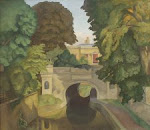
Christopher Nevinson (1889-1946), "The Old Harbour"
Symons wrote an essay about the time that he spent in Sligo. The essay contains the following passage:
"And if you go a little in from the sea-edge, over the green lands, you will come to a great pool, where the waters are never troubled nor the reeds still; but there is always a sighing of wind in the reeds, as of a very gentle and melancholy peace."
Arthur Symons, "In Sligo: Rosses Point and Glencar,"
Cities and Sea-Coasts and Islands (1918).
I presume that he is writing about the same reeds and the same pool that appear in the poem, and it is interesting to see how the poetry goes beyond the prose. The poem is built upon repetition, both of phrase and of rhyme. First, of course, "I heard the sighing of the reeds" begins each of the first four stanzas, changing to "I
hear the sighing of the reeds" in the final stanza. Further, in the first three stanzas, "sighing" in the middle of the first line rhymes with the final word of the third line.
In addition, consider the repetition of sounds in "the whirring wild ducks" (line 7) and "the sea-gull's wheeling flight" (line 8). Consider also "day after day, night after night" in line 6, followed later by "night after night, day after day" in line 10, and "some old dream I had forgotten" in line 15, followed later by "some old peace I had forgotten" in line 19. And, finally, notice line 18: "is it in vain, is it in vain." The poem is an embodiment of the sound and the movement of the reeds (and of the wind and the sea).
Christopher Nevinson, "Silver Estuary" (c. 1925-1927)