
Yesterday afternoon, beneath a cloudless sky, I walked west down an avenue of trees beside a marina. A pleasant breeze -- without the underlying chill that often accompanies late summer breezes -- caused the rigging of the sailboats on my left to whistle and whirr, while the tackle tinkled like cowbells in a distant Alpine meadow.
A hundred or so yards in front of me, the waters of Puget Sound glittered silver and blue, stretching to the green-blue islands and mountains on the opposite shore. Out on the Sound, about a quarter of a mile away, a large white cruise ship headed north to Canada and Alaska.
And the leaves, what of the leaves? The leaves are still mostly green, although a few yellow precursors spun down around me as I walked. A few others followed me down the path toward the water. Gentle reminders.
As I walked, a thought occurred to me: "What if eternity is like this?"

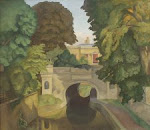
James McIntosh Patrick (1907-1998), "Byroad near Kingoodie" (1962)
Thomas Hardy dated the following poem "November 8, 1923." Yet I think the poem has a September feel to it.
The Best She Could
Nine leaves a minute
Swim down shakily;
Each one fain would spin it
Straight to earth; but, see,
How the sharp airs win it
Slantwise away! -- Hear it say,
"Now we have finished our summer show
Of what we knew the way to do:
Alas, not much! But, as things go,
As fair as any. And night-time calls,
And the curtain falls!"
Sunlight goes on shining
As if no frost were here,
Blackbirds seem designing
Where to build next year;
Yet is warmth declining:
And still the day seems to say,
"Saw you how Dame Summer drest?
Of all God taught her she bethought her!
Alas, not much! And yet the best
She could, within the too short time
Granted her prime."
Thomas Hardy, Human Shows, Far Phantasies, Songs, and Trifles (1925).
"Nine leaves a minute/Swim down shakily" brings to mind a lovely line by Edward Thomas: "The hundred last leaves stream upon the willow."

James McIntosh Patrick, "Road to Craigowl"
For me, September has two opposing poles. First: "Before us lies eternity; our souls/Are love, and a continual farewell." The prelude to which is this:
The woods were round them, and the yellow leaves
Fell like faint meteors in the gloom, and once
A rabbit old and lame limped down the path --
Autumn was over him.
W. B. Yeats, "Ephemera," The Wanderings of Oisin and Other Poems (1889).
Here is the other pole.
This Solitude of Cataracts
He never felt twice the same about the flecked river,
Which kept flowing and never the same way twice, flowing
Through many places, as if it stood still in one,
Fixed like a lake on which the wild ducks fluttered,
Ruffling its common reflections, thought-like Monadnocks.
There seemed to be an apostrophe that was not spoken.
There was so much that was real that was not real at all.
He wanted to feel the same way over and over.
He wanted the river to go on flowing the same way,
To keep on flowing. He wanted to walk beside it,
Under the buttonwoods, beneath a moon nailed fast.
He wanted his heart to stop beating and his mind to rest
In a permanent realization, without any wild ducks
Or mountains that were not mountains, just to know how it would be,
Just to know how it would feel, released from destruction,
To be a bronze man breathing under archaic lapis,
Without the oscillations of planetary pass-pass,
Breathing his bronzen breath at the azury center of time.
Wallace Stevens, The Auroras of Autumn (1950).
The poem begins with a restated version of Heraclitus's famous dictum, which has often been visited by poets. (For instance, Derek Mahon in "Heraclitus on Rivers" and Louis MacNeice in "Variation on Heraclitus.") But Stevens is not content with Heraclitus's axiom. Thus, the heart of the poem begins with: "He wanted to feel the same way over and over./He wanted the river to go on flowing the same way,/To keep on flowing." Which leads, ultimately, to the wish to be "released from destruction."
But Stevens, Yeats, and the rest of us know that release from destruction is not in the cards.
And yet, and yet . . . as I walked down the path yesterday under the trees, toward the glittering water, I wanted the moment never to end.

James McIntosh Patrick, "Autumn Afternoon"


